How Conductivity Meters Optimize Irrigation & Soil Management
🌱 Water Quality Hub 📅 March 20, 2026 ⏱ 13 min read ⚡ soil EC · irrigation · salinity · precision ag
🌾 From guesswork to data-driven farming — Soil and water electrical conductivity (EC) is a master variable in agriculture: it governs water uptake, nutrient availability, and salinity stress. This article explores how modern conductivity meters — from handheld probes to wireless sensor networks — empower farmers to optimize irrigation scheduling, prevent salt damage, manage fertigation precisely, and ultimately increase yield while conserving water.
1. Why EC Matters: The Hidden Link Between Salts and Crops
Electrical conductivity measures the total ion concentration in water or soil solution. In agriculture, EC directly relates to:
-
Salinity stress: High EC in irrigation water or soil creates osmotic pressure, making it harder for roots to absorb water — even if the soil is moist. This "physiological drought" stunts growth and reduces yield [citation:2].
-
Nutrient availability: Essential nutrients (K⁺, Ca²⁺, Mg²⁺, NO₃⁻) are ions. Very low EC may indicate nutrient deficiency; very high EC signals excess salts or fertilizer buildup.
-
Soil structure: Excessive sodium (high EC with high SAR) degrades soil aggregation, leading to crusting and reduced infiltration.
📊 Research insight: A 2025 low-cost soil sensor study showed EC strongly correlated with KNO₃ concentration (R² = 0.9898) and increased with water content — proving that EC monitoring captures both salinity and moisture dynamics [citation:1].
2. Irrigation Water Quality: Real-Time Salt Monitoring
Water sources (rivers, wells, reservoirs) can vary dramatically in salinity due to drought, tidal intrusion, or upstream discharges. Continuous EC monitoring protects crops from sudden salt events [citation:4].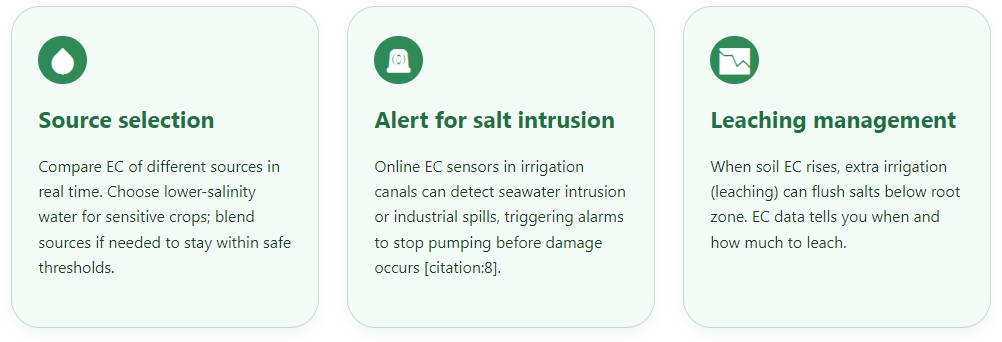
In a rice paddy study (SMART-PADDY project), wireless EC nodes in irrigation channels reduced water consumption and prevented yield loss by enabling real‑time salinity management [citation:8].
3. Soil Salinity Monitoring: From Point Data to Field Maps
Soil EC varies spatially and with depth. Conductivity meters — either portable probes or buried sensor arrays — reveal salt hotspots and vertical distribution.
3.1 Depth Dynamics
Research in Xinjiang farmland using buried salinity sensors showed that EC at 10 cm depth increases rapidly between irrigations and drops sharply during irrigation. At 30 cm, EC fluctuates more slowly; at 60 cm, changes are minimal. This knowledge helps schedule irrigation to push salts below the root zone [citation:3].
3.2 High‑Salt Environments
Coastal saline soils pose special challenges. Recent work at Nanjing Geological Survey compared 8 sensor types in high‑salt soils and developed correction formulas to maintain accuracy, proposing ECsat (saturated paste EC) as a stable metric for long‑term monitoring [citation:6].
4. Fertigation: Closed‑Loop Nutrient Dosing
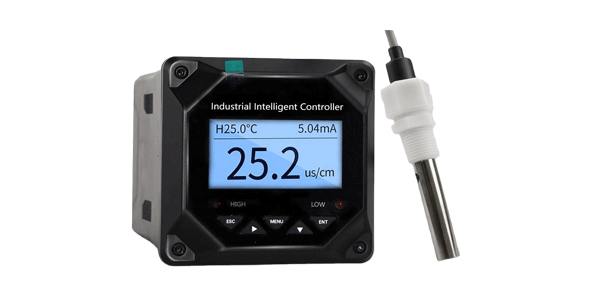
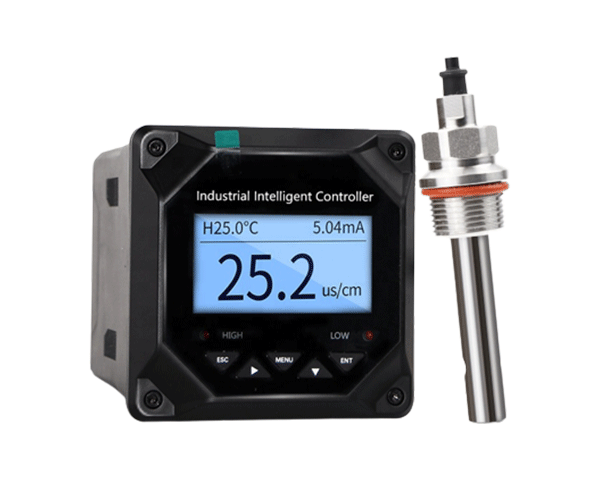
In greenhouses and high‑value crops, fertilizers are injected into irrigation water (fertigation). EC is the key control parameter: it reflects total dissolved nutrients. Modern EC controllers automatically adjust injector ratios to maintain target EC, ensuring optimal nutrition without waste or toxicity [citation:7].
-
Mixing accuracy: EC sensors in the fertigation line verify that stock solutions are diluted correctly.
-
Leaching prevention: If substrate EC rises too high (e.g., in rockwool), the system can increase irrigation or switch to pure water.
The STEPS EC3000, for example, is widely used in horticulture to control nutrient solutions for hydroponics and substrate cultivation [citation:7].
5. Evaluating Soil Amendments with EC
Soil EC is a sensitive indicator of amendment effectiveness. A 2025 column study on saline soils showed that adding biochar reduced soil EC by 10–23% while increasing moisture content, because biochar adsorbs Na⁺ and Cl⁻ and improves pore structure [citation:9]. Regular EC monitoring helps farmers verify that remediation efforts are working.
6. The Future: Wireless EC Networks & AI Predictions
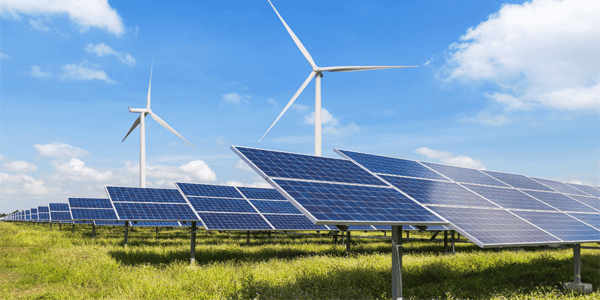
Autonomous, solar‑powered EC sensor nodes now stream data to the cloud. The EU‑funded SMART‑PADDY project deployed nodes in rice paddies measuring EC from 0.3 to 6.0 dS/m with ±0.5°C temperature compensation. Farmers accessed online dashboards to see salinity trends and adjust flooding in real time, increasing yield and saving water [citation:8].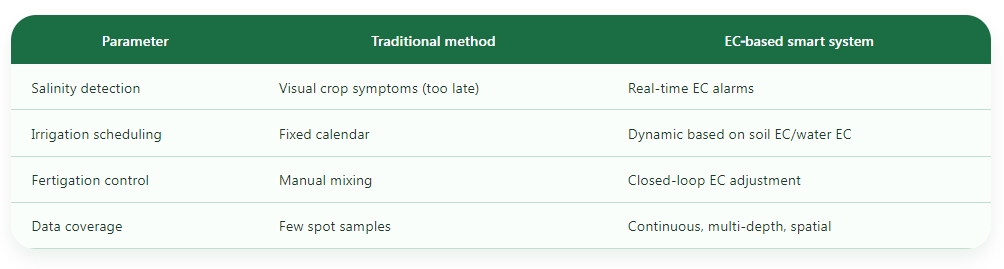
6.1 Machine Learning Integration
Recent IEEE research combined impedance spectroscopy with machine learning (Random Forest, MLP) to predict NaCl and MgSO₄ concentrations in irrigation water with 55 ppm accuracy — paving the way for predictive salinity management [citation:2].
7. Practical Recommendations for Growers
-
For irrigation water: Install an inline EC sensor at the pump or head of the field. Set thresholds based on crop tolerance (e.g., <0.7 dS/m for sensitive crops like beans; <3 dS/m for barley).
-
For soil: Use portable probes for spot checks, or install buried sensors at 10, 30, and 60 cm to track salt movement. Calibrate with saturated paste extracts periodically.
-
For fertigation: Maintain target EC for each crop stage (e.g., tomato: 2–4 dS/m in hydroponics). Use meters with automatic temperature compensation.
-
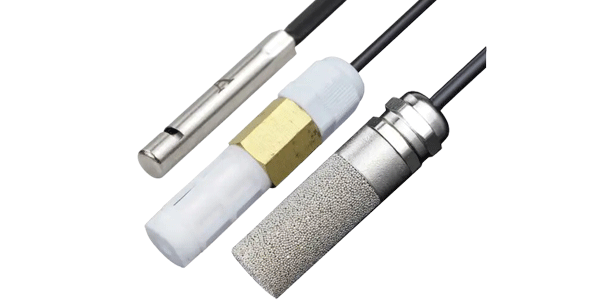
Sensor selection: In saline or corrosive soils, choose electrodes with robust materials (stainless steel, platinum) and IP68 protection [citation:10].
📈 Case Study: Coastal Agriculture – Seawater Desalination for Irrigation
A large seawater desalination project (1.96 billion RMB) produces fresh water from feedwater at 49 mS/cm. The product water is used for irrigation, and online conductivity meters monitor every stage to ensure salinity stays below crop thresholds. This investment secures vegetable production in an area previously plagued by salt intrusion [citation:4].
8. Why It Pays: ROI of EC Monitoring
-
Water savings: Precise irrigation reduces overwatering by 20–30%.
-
Yield protection: Avoiding salt damage can prevent 10–50% yield loss in sensitive crops.
-
Fertilizer efficiency: Closed‑loop fertigation cuts fertilizer use by up to 30% without compromising nutrition.
-
Soil preservation: Prevents long‑term salinization and loss of arable land.
Conclusion
Electrical conductivity has evolved from a lab parameter to a core precision agriculture tool. Whether it's a handheld meter for spot checks, a buried sensor array tracking salt dynamics, or a wireless network feeding AI models, EC data empowers farmers to irrigate smarter, fertilize more efficiently, and protect soils from salinization. As sensor costs fall and connectivity improves, EC‑driven management will become standard practice — securing food production in an era of water scarcity and climate change.